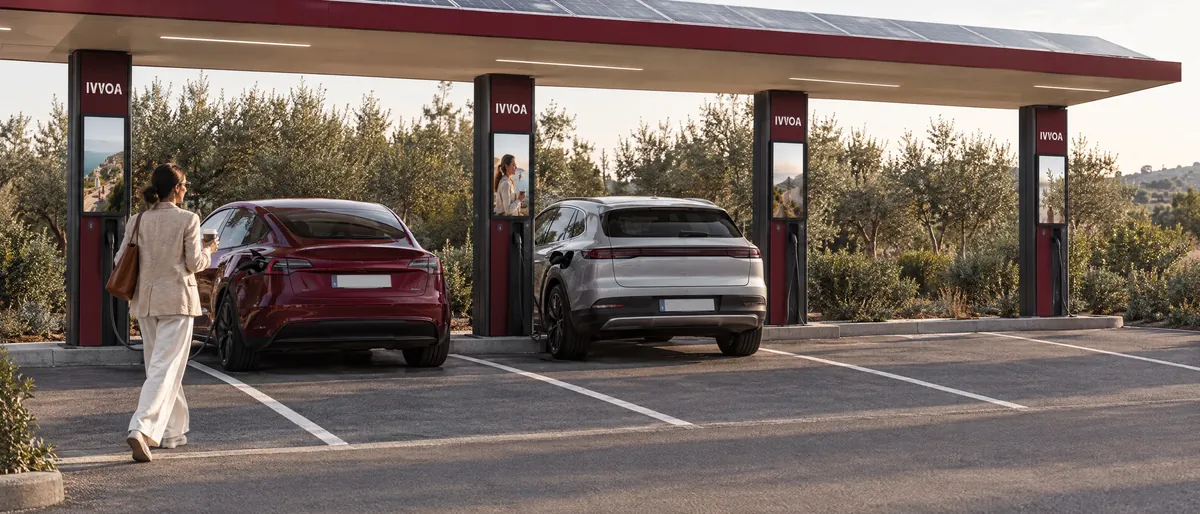
The loop.
IVVOA chargers engage drivers with large screens that carry advertising, sponsored content and creative media. Wherever media and sponsors support it, that income funds a complimentary energy allowance, stated in kilowatt-hours. The allowance brings drivers. Drivers bring time and attention, and attention makes the screens more valuable. Each turn of the loop makes the next one stronger. The paid rate is shown before anyone plugs in, and the change from complimentary to paid is always visible on the screen and in the app. No surprises at the end of a journey.
Why it is an engine, not a tactic.
Advertisers pay more every year for audiences in physical places, because those audiences are real, present and measurable. Global digital out-of-home advertising reached 27.5 billion dollars in 2025, its fourth consecutive year of double digit growth. A charging stop produces exactly that audience: a person who has stopped, at a known location, for a known time, with a known reason to be there. In Türkiye, drivers spent 17.6 million hours at public chargers in the first half of 2026, at an average of about 68 minutes a session. Almost no charging site was designed to serve that audience.
A billboard estimates who passed. A charging session knows who stopped, for how long, and what they did next, in aggregate and never by name. That is why media revenue can carry a complimentary allowance where price competition cannot. Remove the media, and the proposition collapses into ordinary competition on price per kilowatt-hour against better capitalized incumbents.
Sponsored charging.
The signature format is simpler than advertising. A brand does not buy space beside the driver. It buys the energy in their car. When a sponsor funds the complimentary allowance, the driver receives energy and is told, on the screen and in the app, who gave it to them. Advertising is tolerated. A gift is remembered, and it is remembered with a name attached.
What keeps it honest.
Not every charger will have a screen, and not every site will have solar. At public sites, screens and sponsors fund the allowance. In formats where the same people return every day, homes, workplaces, fleets and campuses, a plan does that work instead. The allowance is always stated in kilowatt-hours, never in minutes, because a kilowatt-hour is energy in your battery, the same for every car and every charger, and a minute is not. And what the network learns about behavior in aggregate is a product; what it learns about a person is not, and no price makes it one.